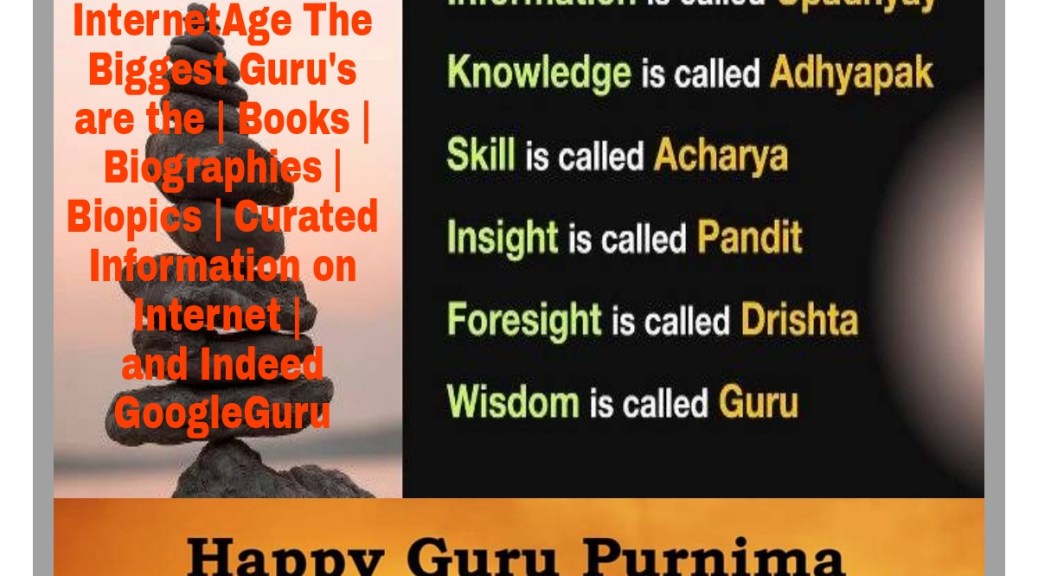
#GuruPurnima
In fact a Guru is not just a teacher, He or She teaches, awakens and achieve realisation.
What then are the differences between different teachings and learning?
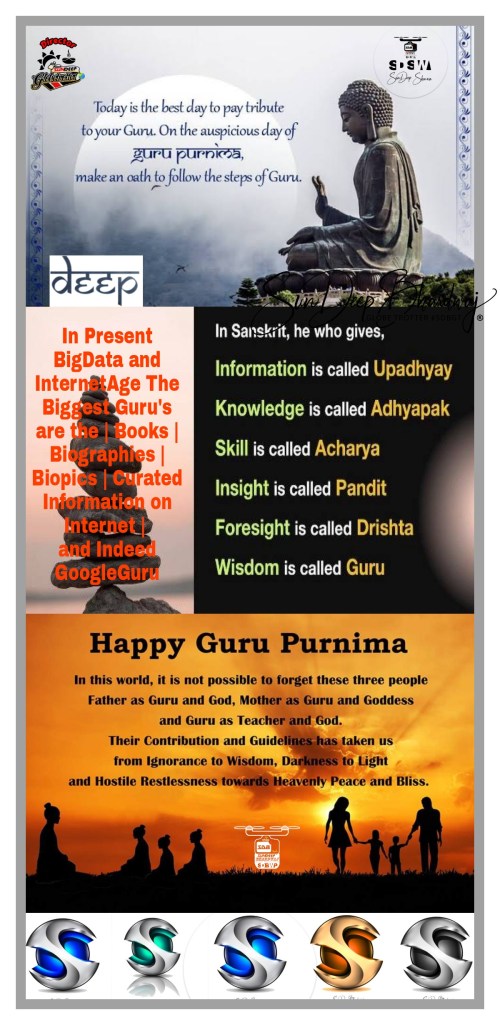
Information – is providing data with context. This has always been a crucial element particularly in the past. where information was a very scarce element in human existence. The one who provides us information is called ‘Upadhyay’
Knowledge – is information that can be readily used or deployed into action. The one who provides us knowledge is called ‘Adhyapak’
Skill – is the ability to readily apply knowledge to action to consistently get superior results, every time all the time. The one who imparts to us the ability to develop skill is called ‘Acharya’
Insight – Is among other things the act of looking within or the result of understanding the inner nature and self. The teacher who imparts the abilities of insight is called a ‘Pandit’.
Foresight – is the ability to look outwards and discern the external nature of things and predict events that are likely to occur in the future. A teacher of foresight is called a ‘Drishta’.
Wisdom – is the realisation of what is right or wrong, what should or should not express or do, and the path to be chosen. Wisdom encompasses the capacity to acquire and process relevant knowledge, to possess great skill with deep insight and foresight. With wisdom emerges the highest quality of human thought and action. The one who makes us realise and attain this state of being, is called a ‘Guru’.
What is the meaning of Guru?
The word Guru is derived from two words, “gu” and “ru”. The letter ‘gu’ refers to darkness or ignorance while the letter ‘ru’ refers to light or spiritual knowledge. So, it‟s a journey from ‘darkness to light’ of understanding. A Guru is the one who removes the darkness of our ignorance. If you follow the foot-steps of Guru, he has the power to take you from death to immortality. Guru guides you to discover who you really are. A Guru lets you express the divinity which is already within you.
Is there any difference between a Teacher and a Guru?
A teacher helps you to understand the world and surrounding, imbibe skills and knowledge. Guru is the one who helps you to find your true ‘Self’. Guru is the energy, the medium through which knowledge flows to the disciple. Guru takes full responsibility of the disciple and literally carries the disciple on the journey of evolution.
Both play significant roles in our lives.
Not Every Teacher is a Guru
All teachers are worthy of respect, but a Guru is beyond even respect
“GururBrahma GururVishnu GururDevo Maheshwaraha
Guru Saakshaat ParaBrahma Tasmai Sri Gurave Namaha”
It means the guru is the creator, the guru is the preserver, and the guru is the destroyer. The guru is the absolute. I bow before you.
We recently celebrated Mother’s Day (Matru Devo Bhav) on 13th May 2018, Father’s Day (Pitra Devo Bhav) on 17th June 2018 and now it‟s the time to celebrate Gurus Day (Acharya Devo Bhava) on 27th July 2018, known as Guru Purnima.
Our country, India (Bharat) has a special day dedicated to celebrating the Guru as the spiritual guide. In various cultures, teachers are honored in different ways. While there is a connection, the Indian idea of Guru Purnima goes much further.
Guru Purnima is the day to pause and note all that you‟ve been given by the universe and celebrate with gratitude. When you feel grateful to someone, it spikes up inner joy and celebration.
Guru Purnima – Guru is Kalpa Taru
Seek On This Auspicious day
“Guru Would Grant You”
About Veda Vyasa
Guru Purnima marks the birthday of Veda Vyasa, who structured the four Vedas, composed the epic of the Mahabharata, and created the foundation for the many Puranas, the vast encyclopedias of Hindu sacred lore. Some of these were Brahma sutra, Commentary on Patanjali Yoga Sutra. He is seen as one of the greatest Gurus in ancient Hindu traditions and a symbol of the Guru-shishya tradition.
Vyasa was not only believed to have born on this day, but also to have started writing the Brahma Sutras on ashadha sudha padyami, which ends on this day.
Rich Ancient Heritage of India
India’s most important gift to the world is its great gurus and their teachings. The term guru itself has entered into many languages and discourses in the East and West. The importance of the guru is one of the pillars of India‟s traditional system of spiritual knowledge. Since Swami Vivekananda in the late 19th century, many monumental teachers have inspired humanity, and awakened India to its true role as the guru among nations.
How is Guru Purnima celebrated?
Guru Purnima is the festival celebrated across India to pay respect to Gurus and seek their blessings. Guru Purnima is also considered an especially beneficial day to practice yogic sadhana and meditation.
How our students should celebrate this day?
For any child, parents and grandparents are their first guru. Children should express their gratitude through mark of an expression or may be a handmade card; to make them feel special on this day. Next comes the teachers, who guide them and imbibe them with knowledge and skills.
Children should be grateful for all that they have and to everyone who is creating this world for them.
A true Guru
The true guru teaches a way of inquiry and meditation so that we can transcend the boundaries of our limited human capacities trapped in the body, mind and senses, and perceive the true essence of our existence and find the true potential within.
In Victorious Kidss Educares, we guide our children to see that Guru in their parents, grand parents, teachers, elders. We are blessed to see in our elders, see in our President Sir Robbin Ghosh who enlighten us all with his legendary presence through words from Vedanta, meanings, enchanted words and exceptional intellect.
‘Guru Purnima’ is the full moon day (Purnima) in the month of Ashadha (June–July). The day is dedicated by Buddhists, Hindus and Jains to their Gurus.
A key element in vibrant civilisations is the beauty of language. Language permits the continuous evolution and refinement of human thought and expression and hence outcomes both in the present and the future. I turn to Sanskrit one of the oldest surviving language in the world.
All teachers are worthy of respect, but a Guru is beyond even respect.
The relationship between Guru and disciple celebrates the highest form of human interaction with we ourselves and the Universe. Gurus, are evolved and enlightened beings, who readily share their wisdom with no monetary expectation*, and thus the teaching is not corrupted by greed or ego.
One is tempted to ask the question, ‘Where will I find a Guru?’
We will not find a Guru, for the Guru finds us.
It is a rule of the universe, What we seek, is also seeking us. Just as the thirsty seeks the water, the water also seeks the thirsty. So it is with the Guru and the disciple. A Guru awaits the true seeker and only the genuine seeker will find a true Guru.
We will find a true Guru, only when we have prepared ourselves.
* Note:
While a Guru never demands payment, however an honorarium, ‘Dakshina’ is gifted to the Guru by the disciple based on his or her means. It is a token of their respect and honour they give their Guru. Usually the Guru passes on the dakshina to someone who will have a need for it.
Preparation comes by living, experiencing success, failure, love, betrayal, joy, sorrow etc.
then daring to question living and the meaning of life.
The Guru facilitates awakening and only an awakened being can evolve and acquire wisdom and achieve realisation.
‘How does one know that he or she has met a true Guru?’
Many who are those who are impatient for instant awakening and wisdom. They seek out a Guru only to be disappointed by individuals who will take advantage of their desperation.
If the seeking is born out of greed for power or wealth we will never find a true Guru.
The Guru in that sense is an emperor, unselfishly having only the best interest of the disciple at heart, while expecting nothing in return.
Wisdom cannot be gifted, inherited, purchased nor stolen. Wisdom can only be realised.
Only he is truly worthy of being an emperor who does not seek power nor wealth. So it is with the Guru. The teacher who facilitates our awakening, evolution and transcendence seeking neither power, nor wealth is a Guru.